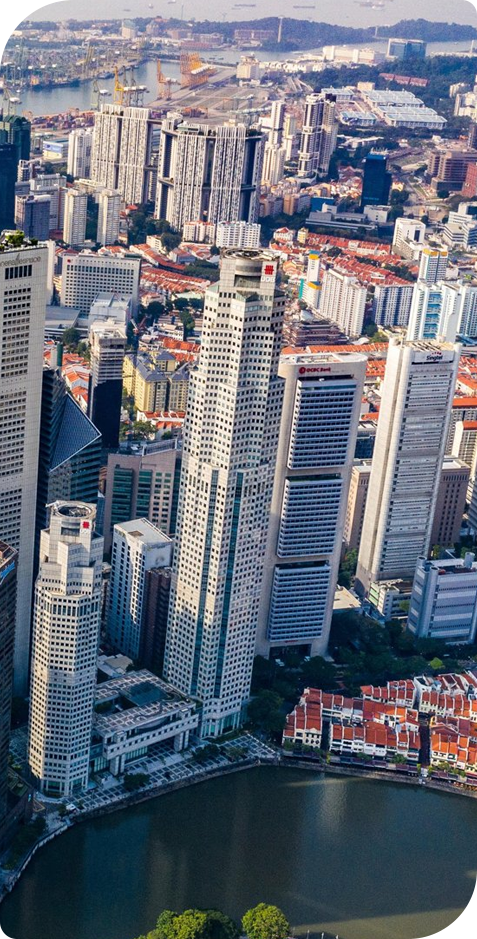
Singapore

OVERVIEW

Located on the southern tip of the Malay Peninsula, according to Malay tradition, Singapore was originally named Singapura by a Sumatran prince after he encountered a strange animal that he took to be a lion.

This was considered to be good luck, and thus, “Singapura” (which means “City of the Lion”) was founded. Once the hub of British power in Southeast Asia, Singapore was occupied by the Japanese during World War II, but reverted to British rule after the war. Eighteen years later, Singapore achieved independence and merged with Malaya, Sabah and Sarawak to form Malaysia. On August 9, 1965, Singapore was separated from Malaysia, becoming an independent republic, and the new country joined the United Nations on September 21 of that same year.

For most of the period since Singapore’s independence, the country was governed under the political leadership of Prime Minister Lee Kuan Yew, who served from 1959 to 1990. High economic growth rates and rapid industrialization since earning independence have placed Singapore among the “Four Asian Tigers,” along with South Korea, Hong Kong and Taiwan. Singapore is a hub for global foreign exchange and boasts one of the busiest ports in the world. Some of the main industries of this booming economy are electronics, chemical exports, financial services and tourism.

Singapore has four official languages: English, Malay, Mandarin Chinese and Tamil. English is the language of instruction for most subjects. Singapore recognizes the importance of a diverse student population and, in 2007, inaugurated the “Singapore Education Awards” to acknowledge exceptional contributions by individuals and organizations in the field of international education

Standing side-by-side, the mosques, synagogues, temples and churches are constant reminders of Singapore’s cultural mix. Singapore’s various ethnic neighborhoods were first formed during the colonial period under the “Raffles Plan,” and today historic Little India, Chinatown and Arab Street are bustling hubs of activity where customs and traditions are proudly celebrated.

FACTS

Singapore is the smallest nation in Southeast Asia consisting of one main island and 60-plus smaller islands and islets; Singapore is populated by people of Chinese, Malay, Indian and European descent. Each group has added its own art, architecture and culinary traditions to the overall culture of Singapore, creating a fascinating backdrop for students in search of a memorable study abroad experience.

Singapore’s postsecondary educational institutions include autonomous universities, private universities and institutions, and polytechnic institutions. Noted for their excellence in education, research and service, the three autonomous universities are the National University of Singapore (NUS), the Nanyang Technological University (NTU) and Singapore Management University (SMU).

Singapore Offers master’s degree programs in public policy, public administration and public management. Engineering and technology, and sciences are the most popular fields of study. It offers undergraduate and graduate programs for future business leaders and entrepreneurs.

Interesting Facts about Singapore

  • Premier education hub which offers students an international perspective and diversity of options.
  • Tuition fees are affordable and the cost of living is still significantly lower than of many developed countries.
  • It is well connected via sea, air and telecommunications to all parts of the world.
  • It is fairly close to India encouraging students to visit home during every academic break.
  • It is consistently acknowledged to be a global business hub with its developed infrastructure, political stability and open business policy.
  • Singapore is one of the best upcoming study destinations for Indian Students. With its offering of world-class universities/ colleges and variety of courses, Singapore is fast overtaking destinations such as Australia and New Zealand in terms of Indian Students applications.
  • The cost of education for an international student in Singapore is far lower compared to the USA and UK, with no dilution in quality of education. Courses in Singapore start at INR 4 lakhs per year compared to INR 6-10 lakhs for the USA and UK.
  • An international student in Singapore is allowed to work up to 20 hours a week during school term, and up to full-time when school is out of term. There are many courses which gives you the permit to work for a couple of years on the student visa.
  • International student that choose to study in Singapore will not only able to compete academically but also has the advantages of the exposure to the different live styles in Singapore, which combines the best from east and west and the multi cultural that available in Singapore.

WHY SINGAPORE

  • Education has always been a key in the growth and development of Singapore society, particularly in the years following 1965 when it became an independent republic. Now in the 21st century, where the knowledge-based economy is the driver in the global community, education has become even more critical in shaping our country’s future.

At the same time, through education, every individual can realize his/her full potential to benefit the community, nation, and lead a personally fulfilling life. Over the years, Singapore has evolved from its traditional British-based education system to one that endeavors to meet the needs of individuals and seeks to nurture talents.

Singapore is emerging as a popular destination to study among the international students. In today’s relentlessly innovating global economy, knowledge is not pursued in isolation. It is advanced by the global community of scholars and knowledge workers operating at the forefront of ideas. Singapore emphasizes on all these aspects and provides very productive and competitive education especially in the field of information technology and managements with good value for money by offering internationally recognized degrees at affordable costs.

Singapore known for its vibrancy and numerous tourist destinations, has some of the top universities of the world. Large sum of money is spent on the education by the government. For higher education, large number of overseas students comes to Singapore to enroll themselves in the colleges and universities of Singapore. There are public and government aided universities in Singapore. If you want to pursue higher education, Singapore is the place to be. The facilities and educational environment make the universities and colleges one of the best.

The strength of Singapore’s Education system lies in its bilingual policy (English with Malay/Mandarin/Tamil) and a broad-based curriculum where innovation and entrepreneurship command a premium.  Individuals acquire the relevant skills and abilities to survive in competitive environments, equipped for a brighter future.

Singapore’s universities education aspires to prepare students not only for today’s world but also for a world where there will be jobs that have yet to be invented and challenges not yet foreseen. 

Education in Singapore
Apart from enjoying a status of famous shopping and tourism destination, Singapore is also emerging as a place for pursuing higher education. The pro-high technology policy of the government has invited billion of dollars of foreign investment in the fields of biotechnology, IT and research. The Ministry of Education (MOE) is responsible for controlling the development and administration of the school and various government-funded educational institutions. In case of private schools, the MOE plays a crucial supervisory and advisory role. Education mainly revolves around the interests of the students. The teaching and pedagogical system follows a flexible approach that helps the students in developing their potentials and aptitudes.
Singapore is one of the best upcoming study destinations for Indian Students. With its offering of world-class universities/colleges and variety of courses, Singapore is fast overtaking destinations such as Australia and New Zealand in terms of Indian Students applications.

Colleges and Universities in Singapore

Singapore is the land of the best schools, colleges, universities and other educational institutes. It is because of this that large number of aspiring students comes to Singapore to pursue their higher educations. National University of Singapore and the Nan yang Technological University are the tow leading public universities in this country. These are also counted among the two most prestigious universities in Asia. The educational institutes have the major objective to impart education of international level and groom the students properly.

The universities basically provide undergraduate and post-graduate courses as well as research programmes. In Singapore, there are two full-fledged public universities, namely, National University of Singapore and Nanyang Technological University, and two private universities, namely, Singapore Management University and SIM University. Many overseas students are looking forward to Singapore as a destination for pursuing higher studies.

International Schools in Singapore

Singapore plays host for many International schools. These schools generally do not give admissions to Singapore students as they are meant for overseas students. If you wish to study in Singapore, do explore the opportunities through these schools.

Last but not the least, the education system in Singapore also indulge in and encourage heavily co-curricular activities, performing arts, youth clubs and societies for overall development of personality of the students.

Lower Costs than USA and UK

The cost of education for an international student in Singapore is far lower compared to the USA and UK, with no dilution in quality of education. Courses in Singapore start at INR 4 lakhs per year compared to INR 6-10 lakhs for the USA and UK.

Earn While Your Learn

An international student in Singapore is allowed to work up to 20 hours a week during school term, and up to full-time when school is out of term. There are many courses which gives you the permit to work for a couple of years on the student visa. You need to check with the University for such Courses.

VISA INFO

As a visa applicant, you must fulfill the following requirements

Application requirements:-

  1. Valid passport.
  2. Valid travel documents including an onward or return ticket.
  3. Sufficient funds.
  4. Two passport-size photos.
  5. Form or letter from college/university in Singapore.
  6. Three completed application forms.
  7. Yellow fever vaccination certificate if passing through or coming from an endemic zone within 6 days of arriving in Singapore.
  8. Local sponsor’s ID card, with photocopy, except for those in Institutes of Higher Learning.
  9. Birth certificate.
  10. Certified copies of highest educational certificates and results.

Cost of a visa

Visa, Social Visit Pass (short-or long-term; S$20), Professional Visit Pass, Student Pass and Transit. Application packs with instructions and prevailing visa costs at the time of application are obtainable from the High Commission.Letter from the sponsor should be included.

Documents Required

Passport-sized photographs of the applicant.
Applicant’s passport showing personal particulars and passport’s date of expiry.
Birth Certificate (certified or notarized copy).

  • All Educational Certificates and transcripts (certified or notarized copy.
  • If applicant has worked before or is working All Employment letters and Salary slip.
  • Bank statement / fixed deposit account / saving account. Bank statement is for documentary proof of financial ability to study & stay in Singapore. It can be from the applicant or applicant’s parents, and the applicant’s parents? Income slip.
  • Parent’s Employment letter and Salary slip.
  • If applicant has time gap between studies and this application: Statement of Declaration & purpose explaining the time gap after your last education, reasons to study in Singapore and plans after graduation.
  • If applying for Master Programmes then Applicant’s resume.
  • If names are different on documents then Affidavit (certified or notarized copy.
  • Passport should be valid for more than six months from the date of return.
  • Visa Application form duly filled and signed.
  • 1 Recent passport size color photograph recently taken strictly against a white background.
  • Covering letter stating the applicant’s name, designation, purpose and duration of stay.
  • All documentary proof of admission into an institute or college.

Financial proof to show substance for the total course duration:-

  • Proof of all previous educational and professional certificates.
  • Proof of accommodation and sustenance in Singapore for the stay duration.
  • Foreign exchange endorsement on passport.
  • Confirmed one-way ticket.
  • Photocopies of bio-data page, pages with endorsement and last 3 pages of the applicant’s passport.
  • Birth Certificate.
  • Certified copies of highest educational certificates and results.

Earning while studying in Singapore

In general, Full time graduate students are allowed to work part-time of up to a maximum of 16 hours per week. However, students need to obtain permission from the (International Student Center) ISC. During vacation, students are allowed to work full time as the Ministry of Manpower has exempted them from applying for work permits.
To acquire an extension, the immigration authorities in Singapore should be contacted. The price of the extension is subject to the immigration officer’s discretion.

CHOOSING SCHOOL

How to choose the university/ colleges in Singapore?

Singapore colleges & university are well regarded throughout the world. There is a great range of opportunities available to international students here: quality secondary school education, a well-established network of colleges & universities. There are opportunities for learning at quality educational institutes in every region of Singapore.


Factor to keep in mind

There are several criteria to choose an institution. For some it could be the country reputation of the university, study programs, size of the institution (some prefer to study in smaller universities), cost effectiveness (some institutions/ countries may be more affordable while others may offer more scholarships or financial aid), placement opportunities and so on.

For some, the presence of Indian students at a particular institution can be a comforting factor. Some of the students aspired to study at an American university and eventually picked Virginia Commonwealth University on account of it being a home to a lot of Asians.

Thus the bottom-line is to choose an institution that best fits your requirements. “Understand your personal requirements – which program you want to pursue, the kind of institution you prefer, size of classroom, student teacher ratio, financial requirements, whether you would prefer a metropolitan or a smaller city/ town and so on to decide about your course and college.

Source of Information
Cambridge Educational Services Pvt. Ltd. is the channel of information, which has helped many students to make their dreams come true. We fulfilled the dreams of large number of the dreamy-eyed.

We represent several institutions and provide guidance to student’s right from picking their institution and course to applying to the institutions and even fulfilling visa formalities. “Since we represent certain universities and are in direct touch with them, we may get a quicker reply from them, which might take months.

Singapore universities admission process for pursuing education
All applications should be accompanied with appropriate certificates.
Students must read the brochure containing the course details and ensure that they fit in the requirements of the course. Few institutes conduct written test and interviews before placement.

If admission is accepted by the University, students will receive a letter of acceptance that needs to duly signed and returned. Online applicants must check status online.
Students will receive a package from the university and should plan to be in Singapore two weeks prior to the commencement of the course.
Scholarships are awarded by the universities themselves for meritorious students.

Under Graduate

  • Most of the universities in Singapore admit international students from India.
  • Students must have completed at least twelve years of education before applying for under graduate courses at Singapore universities.
  • Though SAT scores are not required for international students, mentioning the scores help gain entry easily.
  • TOEFL scores are mandatory for students seeking admission in Singapore. Final interviews might be conducted before gaining admission into any of the universities. |

Post Graduate

  • Students willing to take up a course in management have to produce GMAT scores.
  • For any post graduation course students have to produce, GRE/GMAT and TOEFL/IELTS scores along with application form.
  • Duly signed letter from the registrar of the last educational university along with relevant degree certificates should be included.
  • Letter of recommendation from tutor must be sent along with application form. Work experience letter should accompany application if the applicant has any prior work experience.
  • A statement from the bank for supporting funds should be produced or a Our Education System.

The key things to note when applying to a school

The school should provide clear and accurate information on the course, the entry requirements, the conduct of the course, fees and other charges as well as terms and conditions relating to areas such as course cancellation and refund policies. The school should also specify the services that it will provide to international students.
For Private Education Organizations (PEOs), all terms and conditions relating to your enrolment into the course should be reflected in a Standard Contract that the PEO will sign with you.
The Standard Contract is available in English, Chinese, Bahasa Indonesia, and Vietnamese. Please note that students are required to sign on the English version ONLY, and the translated versions are simply used as a reference.

For private schools or PEIs, how would I know whether the PEI that I am applying to is reputable and credible?

All PEI’s currently need to be registered with the Council for Private Education in order to operate in Singapore and the registration process takes into account the PEI’s corporate governance, quality of provision and information transparency.

In addition, PEI’s that take in international students need to have Edu.Trust certification. There are 3 levels of EduTrust certification – Edu.Trust Star (valid for 4 years), Edu.Trust (valid for 4 years) and EduTrust Provisional (valid for 1 year).

PEI’s must seek approval from the Council for Private Education to offer any external degrees offered in partnership with bona fide universities and they are only allowed to offer qualifications of up to Advanced Diploma level in their own name.

A Fee Protection Scheme has also been established to protect the tuition fees of students studying at PEI. It is a mandate that PEI’s have to either deposit the fees in an escrow account or purchase insurance protection administered by CPE-approved companies.

Who can help me if I have problems with the school, or with the course?

You should try to resolve the problem with the school first.
If the school is unable to resolve the issue, you can approach:

  • Follow CESPL on Twitter

    @cambridgedu on Twitter
  • Contact CESPL

    CAMBRIDGE EDUCATIONAL SERVICES Pvt.Ltd.

    +91- 181 5094955, 5081275,4639999

    E-Mail: info@cambridgedu.com

  • Like us on Facebook